
Hi there! So, Setember was another rough month for me mentally, so I haven’t been able to put out as many posts as I was hoping to, but I wanted to make sure my next favorite book of the month post was up before we reached October. I mean, someone’s got to wake me up before September ends. (That is a bad joke, will always be a bad joke, but it will never keep me from making it). **And as always, the work to support the Black community is not done, whether there is media coverage for it or not, so here is the link to click in order to support the Black Lives Matter movement in any way you can, and thank you to StarlahReads for compiling these resources.**
My favorite book that I read in the month of August was Real Life, a profound literary fiction written by Brandon Taylor. I became aware of this book back in June, when Dahlia Adler, over at LGBTQReads, was recommending books for my monthly Patreon reward. I was immediately drawn to the cover, which depicts gel electrophoresis, and was intrigued by the biochemistry major aspect, as that is what I studied in college for two years. I do not typically lean towards literary fiction, and knew I wanted to take my time with it and not rush to finish. What I found was an exceptionally written debut that discusses the harrowing nature of being a minority in a science field, dealing with past trauma and an uncertain future. I was blown away to say the least.
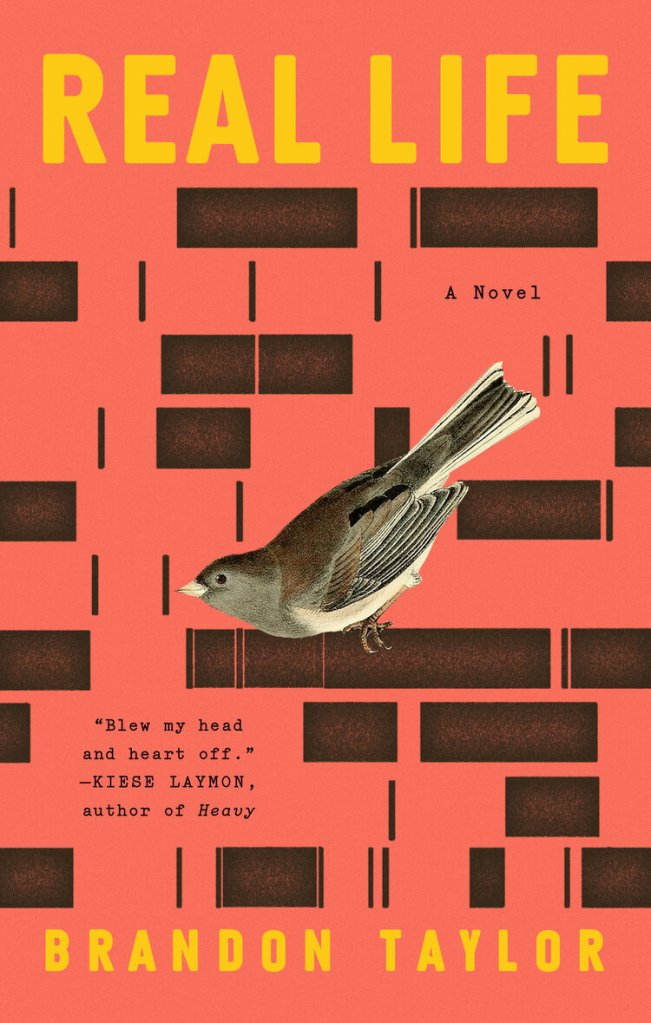
Description from Goodreads: Almost everything about Wallace is at odds with the Midwestern university town where he is working uneasily toward a biochem degree. An introverted young man from Alabama, black and queer, he has left behind his family without escaping the long shadows of his childhood. For reasons of self-preservation, Wallace has enforced a wary distance even within his own circle of friends—some dating each other, some dating women, some feigning straightness. But over the course of a late-summer weekend, a series of confrontations with colleagues, and an unexpected encounter with an ostensibly straight, white classmate, conspire to fracture his defenses while exposing long-hidden currents of hostility and desire within their community. **Trigger warnings for childhood abuse, sexual assault, and racist and homophobic language**
From the moment I started this book, I knew it was going to be memorable. From the prose to the scientific background to the deep exploration of pain and grief, I knew I needed to take this slow and not binge it like I would normally do with my typical contemporary read. It’s written in 3rd person for most of the book, skipping to 1st person with no paragraph breaks when revisiting an experience from the past, and we constantly see inside Wallace’s head. He is struggling, but not in the way any one of his friends believes, yet most of the time he is the one that has to console them when they are upset. It was frustrating and difficult to read at times because Wallace is so set in his ways, which will lead him down a path of mental destruction, but every time he reaches out for help he is ignored. There was such an intricate discussion about overt and covert racism and homophobia, especially within the science community, which I found to be incredibly well done. There was one instance when Wallace and a female classmate are having an argument inside the lab, where she is spewing racist and homophobic remarks at him, so he gets angry and leaves, and later finds that she had written an email to the lab director painting him as the villain and a misogynist, and is not believed when he pleads his case. Maybe part of the reason Wallace can be such a frustrating character to read about is because he never wants to talk about his feelings – even when people directly hurt him, ruining his research experiment, for example, he will sit on it, acknowledge it, and move on, then get angry at everyone else when they bring it up in the future because he’s over it so they should be too. I think that, in part, is due to his trauma, and the fact that when he never felt like he could talk about how he was feeling growing up, otherwise he’d be ridiculed or beaten. I feel like a lot of people will be able to relate to some part of Wallace’s struggle, no matter their identity.
This book isn’t perfect by any means, and I believe that anyone, even those who love it to pieces, will be able to point out and agree with criticisms made against it. The book, and all of its characters, is messy. But isn’t life? And maybe that’s the point? The mental and physical struggles you may bear due to trauma from the past, learning to cope with the fact that your collegues, who may be the only people you have in your life, are celebrating your every failure, being taken advantage of by the ones you care for the most, and the ones you thought would take care of you – it’s rough. Life is rough. Life can be beautiful, and hopeful, but a lot of times it isn’t. And perhaps that’s exactly what Brandon Taylor was trying to convey. But hey, that’s just how I felt after reading.
Real Life has been shortlisted for The 2020 Booker Prize, and it’s no surprise. Brandon Taylor has been able to craft a powerful and lacerating novel that discusses the cost of overcoming the blows that have left us wounded and scarred, and explores microaggresions faced as a person of color in the science industry. I am so glad that I was recommended this book, and will without a doubt pick up whatever Taylor has in store next.
I think it’s also important to check out this Guardian author interview where Brandon Taylor discusses how he doesn’t want to be viewed as 2020’s token queer black author.
Places to find Real Life:
Amazon
Goodreads
Brandon Taylor’s site
Penguin Random House
 Thoughts About Things