
Hello! I’m back from a bit of a break to talk about a non-fiction title close to my heart that releases today! **And every day we are reminded that discrimination against marginalized communities is still a serious problem, so click here to find a compilation of resources where you can donate your time, money, or whatever you can to support these communities. I still encourage you to research these causes on your own to educate yourself and find the best way to lend your support.**
Ever since I read Ace: What Asexuality Reveals About Desire, Society, and the Meaning of Sex by Angela Chen, which released in 2020, I’ve been on the look-out for new non-fiction works detailing asexuality and all of its intricacies. While scrolling NetGalley, I came across Ace Voices: What it Means to Be Asexual, Aromantic, Demi, or Grey-Ace, I was intrigued. It’s actually the first of five works currently on my NetGalley queue regarding asexuality, and as someone who identifies somewhere on the ace (and aro) spectrum, I could not be more excited to see more representation like this in media. So let’s talk about Ace Voices.
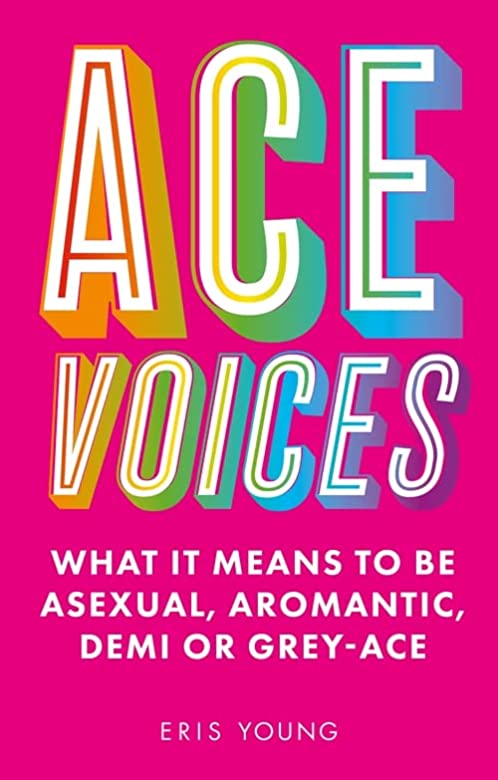
from Goodreads / the publisher: “Drawing upon interviews with a wide range of people across the asexual spectrum, Eris Young is here to take you on an empowering, enriching journey through the rich multitudes of asexual life. With chapters spanning everything from dating, relationships and sex, to mental and emotional health, family, community and joy, the inspirational stories and personal experiences within these pages speak to aces living and loving in unique ways. Find support amongst the diverse narratives of aces sex-repulsed and sex-favorable, alongside voices exploring what it means to be black and ace, to be queer and ace, or ace and multi-partnered – and use it as a springboard for your own ace growth. Do you see a story like your own?”
There were some things I loved about this book, some conversations and discussions that are incredibly important and experiences shared that were vulnerable and have the capacity to assist an individual reading this book with their own journey, parsing through confusion and arriving at self-acceptance. There were times I was just confused as to the audience the book intends. Ace Voices serves to share as the experiences of people who identify as ace all across the spectrum, and highlights how although we may share the same label, our thoughts, feelings, ideas, and motivations can be completely varied depending on different aspects of our lives. I’m just not sure if this book serves the purpose of seeking out individuals already on the ace spectrum, looking to find that sense of community, or as a means of education to those not sharing of our identity. Truly anyone can pick up this book (or any non-fiction) and learn something, but at times I felt this book seemed a little lost in its purpose. I was also a little confused when I saw the title and subtitle listed. “Ace Voices,” makes it clear that the book will incorporate the voices of people who identify as ace, or asexual. Then the subtitle brings in “aromantic, demi, and gray-ace.” Demi and gray-ace address how some individuals fall on the ace spectrum, but aromantic addresses an entirely different type of attraction. While it can be said that many people who are asexual also identify as aromantic, or somewhere on the aromantic spectrum, they are separate. Some parts of the book did discuss how romantic attraction can and does affect one’s outlook on their sexual identity, the author uses the term “a-spec” throughout the book, which is sometimes used to shorten the asexual spectrum and sometimes used to combine both the aromantic and asexual spectrums. Personally, I felt like naming the book “A-Spec Voices,” might have been more beneficial to achieve the author’s goal, but that is simply my opinion.
A small aspect of the book that irked me, but I won’t spend too much time on because I think it’s personal preference, was the fact that the individuals interviewed are addressed only by their initials. I understand it might have been key to aide in allowing them to retain a form of anonymity for this project, but sometimes, when their experiences were discussed several chapters apart, it made it hard for me to make those connections. The way this author incorporates their own personal journey with their gender and sexual identity, with the experiences of additional individuals to compare, was a fine way of presenting this information, I just wish it was easier to see how the different topics are seen through the lens of one individual (like perhaps an index listing the interviewees initials and the pages where their quotes appear.)
There are several discussions addressed in this book that I want to highlight specifically. First is the obvious, that no two a-spec people are the same. No two individuals interviewed for inclusion in this book had the same thoughts for every topic brought up, because our lived experiences can shape our thought processes and allow us to feel things differently. We all have our own boundaries that are constantly being explored, and just because you know one a-spec person does not mean you know how we’ll all react in certain situations. Second, that just because asexuality is sometimes framed as a “lack,” that doesn’t mean we deserve to be treated as “less.” The world is constantly catering towards a society that feels at least some kind of sexual attraction, and those of us who don’t are either cast aside or, worse, infantilized and treated as though sex is something we simply “don’t understand.” We understand just fine, and sometimes we are even more in-tune with our sexual identities, and what we feel comfortable with, because we might have to do more self-reflection that the average allosexual person. Just because you don’t understand our identity, does not mean we do not exist. And lastly, I loved the final chapter titled “Joy.” It truly was a celebration of both our similarities and our differences as a-spec individuals, and how we should strive to be proud of who we are and how far we’ve come in our journeys. It won’t always be easy, sifting through confusion and denial, and the feelings of worthlessness we may feel sometimes. But we are all unique, and we are all wonderful in our own ways.
While I didn’t find Ace Voices to be a perfect book, I still found myself relating to many of the thoughts shared by those who were interviewed. It’s easy to feel so alone, especially when society tries to ostracize people who they deem to be too different from the norm, but it was so nice to so such a variety of experiences of those who belong to the same community. I can’t wait for 2023 and all the non-fiction surrounding asexuality to come. I’m honestly so excited to see the different styles and takes. Ace Voices is set to release on December 21st, 2022, which is the day this post goes live, so please join me in wishing it a happy book birthday and consider picking up a copy for yourself if you’re interested. *Thank you to NetGalley and the publisher, Jessica Kingsley Publishers, for the e-copy, all thoughts and opinions are my own.*
Where to find Ace Voices:
Bookshop
Amazon
Goodreads
Storygraph
Eris Young’s site
Hachette UK
 Thoughts About Things