
Hi there! I’m here to talk about a new non-fiction surrounding the topic of asexuality and aromanticism. **And every day we are reminded that discrimination against marginalized communities is still a serious problem, so click here to find a compilation of resources where you can donate your time, money, or whatever you can to support these communities. I still encourage you to research these causes on your own to educate yourself and find the best way to lend your support.**
Sounds Fake But Okay is another book that I found while scrolling through the Read Now section on NetGalley. As someone who identifies on both the aro and ace spectrums, I’m always open to reading books that feature those topics, especially those written by individuals who also identify in that way. When picking this up I didn’t realize the authors are also hosts of a podcast with the same name, which aired its first episode in 2017. From the podcast’s website, “Sounds Fake But Okay is a weekly podcast where an aromantic asexual girl and a biromantic demisexual girl talk about love, relationships, sexuality, & pretty much anything else they just don’t understand.” Sarah (aro ace) and Kayla (demisexual) roomed together their freshman year of college at the University of Michigan, and became best friends through all the thick and thin of college and life that comes after. So it was really interesting to see how the stylistic choices from these podcast hosts played out while writing a book.
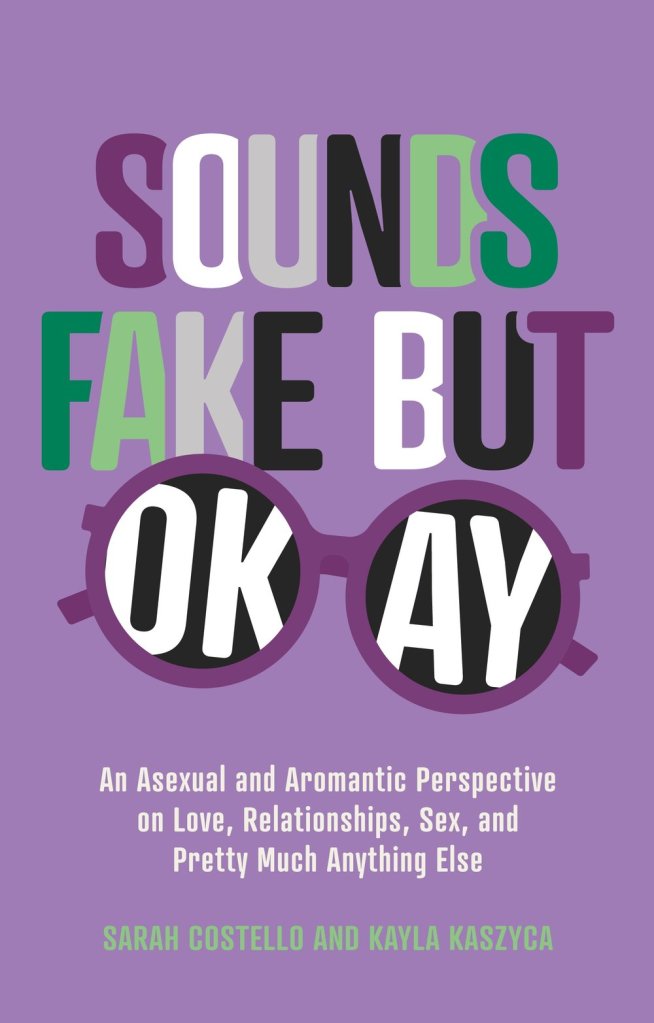
From the book description, in Sounds Fake But Okay, “Sarah and Kayla invite you to put on your purple aspec glasses – and rethink everything you thought you knew about society, friendship, sex, romance and more. Drawing on their personal stories, and those of aspec friends all over the world, prepare to explore your microlabels, investigate different models of partnership, delve into the intersection of gender norms and compulsory sexuality and reconsider the meaning of sex – when allosexual attraction is out of the equation.” What I’ve noticed when reading non-fiction that deals with the aspec community is that each book will have a really strong topic that I love the conversation around, but a lot else will fall flat. So let me focus on the positives first. I think this is one of the only books I’ve read so far that touches on aplatonic individuals – people who feel little to no platonic attraction. While certainly not as common as asexual or aromantic individuals, aplatonic people do exist and have their own ways of feeling and expressing love, and they should be respected and appreciated like anyone else. I always like how books like these will include quotes from other people who identify differently from the authors, to get their unique perspectives on certain topics. I also did appreciate their inclusion of quotes from an interviewee who, at the time, identified on the asexual spectrum but, as she transitioned, realized that label no longer fit. The discussion around labels is always a fascinating, and I liked how this highlighted the fluidity of labels and how you know yourself best, so if the label doesn’t quite fit anymore there’s no reason to still squeeze yourself into it – allow yourself to learn what words and language fit how you’re feeling in that moment.
While I did have some positive things to say about this book, I have some very serious flaws I would like to point out. First, parts of the writing style did not work well for me. This could be due to it being more conversational, which makes sense as the authors are podcast hosts, but sometimes the voice would switch from third to first person, and several phrases were used so often that it took me out of the book (the terms “aspec lens” and “purple-colored glasses” were repeated so much I started to physically react every time I read those words). The authors do make a note of stating clearing and evidently their biases – both are cisgender white women with a Western view on things – but a lot of the discussions, when not including quotes from other people with different lived experiences, felt very basic and over-arching that it felt like it was addressing the entire community as a whole, instead of the pockets it should be highlighting. I had a hard time deciphering who the intended audience of this book was. Some of the marketing material stated that it is a “guide to help aspec people become more confident in their identities and understand their relationships,” but if this was set up as a guide for people on the aro and ace spectrums, why, as a reader, are we told so often to put on our “purple colored glasses?” Shouldn’t we, as aspec people, already be looking at the world, or at least different aspects of it, with that lens already in mind? And even still, there isn’t one prescription of these glasses, because even as aspec individuals we can still view the world in ways different from other aspecs depending on other factors and lived experiences. One last thing I will mention is that in the final chapter of the book, there is a paragraph that mentions J.K. Rowling, and Harry Potter in a positive light. Considering all the harm Rowling has caused directly to the trans community, I felt like inclusion of this paragraph was not needed and harms the talking points of the chapter, if not the book. I will point out that this was written in my advanced reader’s copy, and am not sure if it is still included in the final edited version. I personally hope for its removal.
In conclusion, I feel like this book is best fit either for individuals looking to learn a little bit more about the asepc community as an outsider, or for people who maybe are beginning to question their sexual and romantic identity and will feel validated by the new aspec lens this book offers them. Otherwise, as an aro ace who has been firm in her identity for several years now, I wasn’t the biggest fan of the writing style, repetitive nature, or single-minded language occasionally used throughout. The aromantic and asexual communities are not a monolith, and no two experiences will ever be exactly the same, so picking this up may help you in your learning or identity-searching journey, but, in my opinion, it did not assist in mine. Sounds Fake But Okay is set to be released on February 21st, 2023, which is the day this post goes live, so please join me in wishing it a happy book birthday and pick up a copy if you’re still interested. *Thanks to NetGalley and the publisher, Jessica Kingsley Publishers, for the early copy, all thoughts and opinions are my own.*
Where to find Sounds Fake But Okay:
Bookshop
Amazon
Goodreads
Storygraph
Jessica Kingsley Publishers
Podcast Site
 Thoughts About Things